
June 10, 2026 /
Jun 04, 2026
The anatomy of the clitoris has implications for women with MS and their partners.
Having a diagnosis of MS and living with MS means having to navigate a complex landscape of sensory changes, numbness, and altered central sensory processing. For many women with MS, this can directly impact sexual function and intimacy. Understanding your own body is a tool to help understand the impact MS has on sexual pleasure.
A newly uploaded anatomical study has completely changed our understanding of the clitoris and its neural pathways. For women with MS and their partners, these new insights into how the clitoris and vulva are wired may offer new possibilities for intimacy, the use of sex aids, and making informed healthcare choices.
Mapping the clitoris in 3D
For a long time, medical illustrations often depicted the clitoral glans (the visible “head” of the clitoris) as having a sparse nerve supply. Because the nerves are largely embedded deep inside the body, standard anatomical dissections struggled to trace them. However, researchers recently used highly advanced, micron-scale 3D imaging technology to map the female pelvis. What they found will rewrite anatomy textbooks:
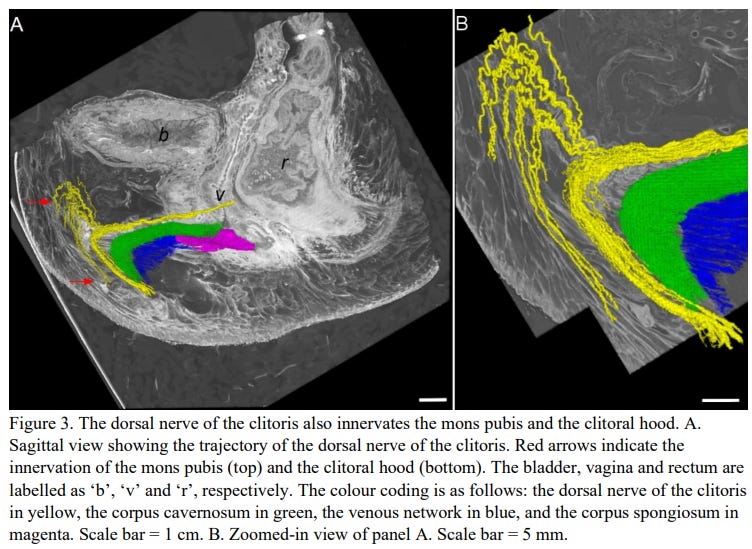
- A “Tree-Like” network: The primary sensory nerve—the dorsal nerve of the clitoris (DNC)—does not just gradually diminish as it reaches the glans. Instead, it forms a highly complex, tree-like branching pattern with nerve trunks projecting outward toward the surface. Against the current dogma, this supports what many women know, that the clitoris is well endowed when it comes to sensory nerves and hence sensory inputs. In fact, it may be the most richly endowed sense organ in the female body.
- Beyond the glans: The sensory wiring extends much further than previously known. Branches of the dorsal nerve of the clitoris actually travel upward to innervate the clitoral hood and the mons pubis.
- Surrounding support: The posterior labial nerve, which is known to supply the labia, was also discovered to innervate the surrounding areas of the clitoral body.
What this may mean for sexual function and MS
Because MS damages the myelin sheath covering the central nerves, you might experience areas of numbness, hypersensitivity, or altered sensation in your genital region. This new anatomical map provides practical information:
- Expanding the erogenous map: If the clitoral glans itself is overly sensitive or numb due to MS nerve lesions, you and your partner can broaden your focus beyond the glans. Since we now know that sensory nerve branches extend extensively into the clitoral hood, the mons pubis, and the lateral aspects of the clitoral body, these areas can also be stimulated to achieve sexual pleasure.
- Optimising sex aids: Understanding that the nerve network is spread out like a canopy—reaching into the mons pubis and labial structures—means that sex toys and vibrators with wider bases or those designed to lie flat against the vulva can stimulate a much larger cluster of nerve endings than previously thought. You don’t have to rely solely on pinpoint stimulation. It would be an interesting study to survey women with MS and controls to see which sex aids work best in women with MS who have sensory problems affecting the vulva.
Impact on vulvar surgery
If you ever need to undergo gynaecological procedures or elect for vulvar surgeries, this research will allow surgeons to be more careful in how they operate so as not to damage the nerve supply to the clitoris and surrounding erogenous areas. Operations around the vulva, such as labiaplasty, have dramatically increased in popularity. These procedures often involve making incisions in the clitoral hood. Previously, surgeons operated with a defined “danger zone” to avoid nerve damage. However, because this new study proves that sensory nerve branches extend beyond this traditional danger zone into the mons pubis, surgeons will now have to update their techniques to prevent accidental nerve damage and loss of sensation. This comprehensive map is also critically important for reconstructive surgery, such as that performed for survivors of female genital mutilation (FGM) or those having gender reassigment procedures.
The gender gap in anatomical science
I doubt it will shock you to learn that in 2026, we are just now mapping the nerve pathways of the clitoris when we have had this information for the penis for more than 30 years. Why did it take so long? The clitoris has historically been one of the least studied organs in the human body. For centuries, scientific investigation was blocked by cultural taboos surrounding female sexuality. In fact, the clitoris was completely excluded from standard anatomy textbooks until the 20th century, and when it was finally added, it was inaccurately dismissed as just “a small version of the penis”.
To read more, click here
Stay informed with MS news and information - Sign-up here
For MS patients, caregivers or clinicians, Care to chat about MS? Join Our online COMMUNITY CHAT